Larger droppings along edges
Fresh-looking droppings near walls, stored goods, feeding areas, basement ledges, or garage corners can indicate active travel. Avoid sweeping dry material.
Seen a rat in the basement or garage? Heard movement in a wall? Start by finding where it got in and where it is traveling—not just where you saw it last.
For homeowners, landlords, property managers, and small commercial property decision-makers.
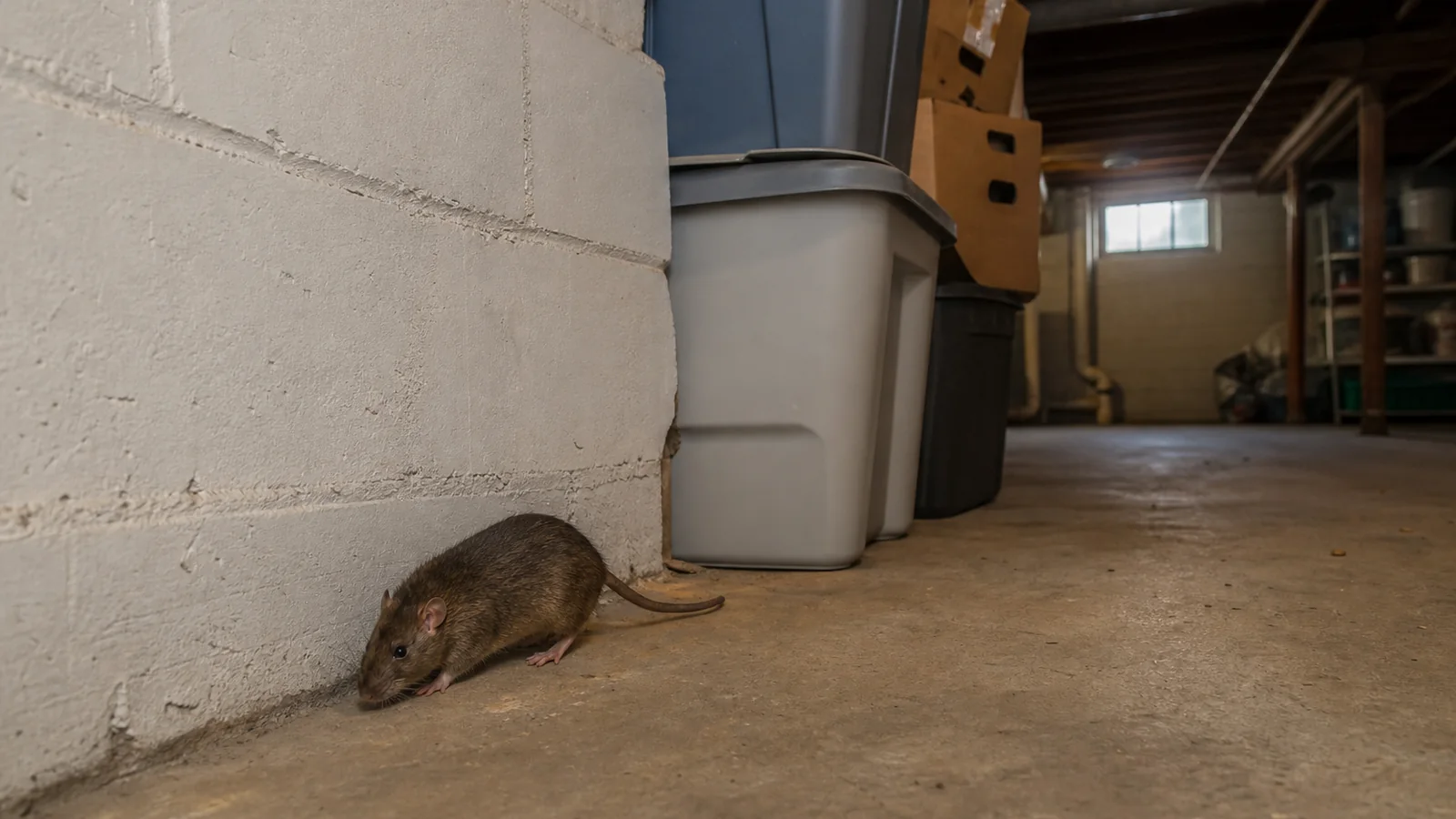
A rat seen crossing a basement floor is memorable, but the more useful questions come next. How did it enter? Where does it travel when the lights come on? Is the activity tied to stored food, a utility opening, a garage edge, a floor drain area, or a gap at the foundation? Has evidence appeared on more than one level?
Rat control in Cleveland should connect interior warning signs with exterior access and shelter. Lower-level spaces deserve particular attention because foundation transitions, service penetrations, bulkhead or basement doors, attached garages, and repairs around pipes can create routes that are easy to miss from a finished room.
Do not assume that one captured animal proves the building is clear. Likewise, one old dropping does not prove current activity. The job is to separate fresh evidence from historic evidence, identify likely travel zones, and choose a response that fits the property.
Record where each sign appears and whether it returns after cleaning or rearranging the area. Patterns are more informative than isolated clues.
Fresh-looking droppings near walls, stored goods, feeding areas, basement ledges, or garage corners can indicate active travel. Avoid sweeping dry material.
Repeated damage to food bins, trash storage, wood, plastic, or other accessible material deserves prompt documentation and inspection.
Strong scratching, bumping, or travel sounds may point to larger animals, but sound alone cannot confirm species or exact location.
Openings near foundations, slabs, vegetation, waste areas, or stored materials can help explain how exterior pressure connects to a building.
Rats using the same narrow edge can leave smears on walls, framing, pipes, or openings. These marks help focus inspection attention.
Torn packages and scattered contents show more than appetite; they reveal where rodents feel protected enough to stop and feed.
Pipe and conduit penetrations, sill areas, masonry gaps, door edges, utility rooms, floor transitions, and concealed perimeter zones can connect exterior access to indoor travel.
Door corners, worn seals, stored materials, wall penetrations, and the junction between attached and occupied space can create both access and cover.
Pet food, bird seed, pantry overflow, recycling, leaks, floor drains, and exterior waste handling can affect where rats concentrate activity.
Wall voids, chases, additions, shared basements, and connected units matter when evidence appears away from a likely ground-level opening.
Share where you saw activity, when it happened, and which level of the building is involved.
Rat extermination services should not be reduced to a product name. The sequence needs to reflect evidence, occupants, access, and the building.
Secure accessible food, pet feed, and waste without aggressively moving every stored item. Sudden disturbance can erase useful evidence or redirect activity.
Separate feeding areas, travel edges, possible nesting cover, and likely entry points. Multi-level or multi-unit activity requires a broader map.
Choose placement and methods according to the property and observed activity, with special care around children, pets, tenants, customers, and food areas.
Activity should be assessed over time rather than judged by a single quiet night. New droppings, sounds, or feeding damage can change the plan.
Once active conditions are understood, practical access points can be prioritized for rat exclusion and building repair.
Rats can disturb stored materials, contaminate surfaces and food, gnaw accessible materials, and nest in protected areas. The response should identify what was exposed instead of treating the entire building as one undifferentiated cleanup zone.
Droppings and nesting material should not be swept or vacuumed dry. Keep people and pets away from affected areas and follow current public-health guidance for ventilation, wet cleaning, protective equipment, and disposal. Extensive contamination or inaccessible material may require specialized cleanup.
Read cleanup and droppings guidance →Basements, attached garages, utility entries, porch or addition transitions, and food-storage areas often need to be read together. Finished walls can hide the route between a lower-level opening and an upstairs sign.
Shared basements, utility chases, tenant reports, common waste areas, and unit turnover complicate the timeline. Documenting where evidence appears helps avoid treating one unit while overlooking a connected route.
Rear doors, deliveries, stock rooms, floor-level penetrations, waste practices, and adjoining occupancies can shape rat pressure. The plan should distinguish building work from operational changes.
Cleveland’s seasonal temperature swings can make protected indoor routes attractive, while basements and garages provide quiet edges that occupants may not inspect every day. Masonry, siding, additions, old and new utility penetrations, window wells, door thresholds, and repairs completed at different times can leave a complicated perimeter.
Local relevance does not mean assuming every older house has rats or that every neighborhood has the same conditions. It means inspecting the actual construction, maintenance history, occupancy, and exterior pressure at the property in front of us.
Rat pressure can differ between adjacent buildings. Recommendations should follow the signs, openings, construction, and operating conditions at the property—not assumptions about a neighborhood.
Keep people and pets away from the immediate area, secure accessible food and waste, and note the time and direction of travel. Avoid tearing into walls or sealing the only visible opening before the active route is understood.
Not necessarily. Foundation and utility openings are important, but rats may also move through garages, connected additions, wall systems, shared spaces, or upper openings before reaching the basement. Inspection should test the route rather than assume it.
It may be part of the response, but upper-level sounds can involve connected chases, wall voids, or a different source. The plan should account for evidence on every affected level.
Immediate sealing can be counterproductive when active animals remain inside or when the opening is still needed to understand movement. Exclusion timing should be coordinated with control and monitoring.
Control addresses active rat activity. Exclusion focuses on denying future access through practical openings and weak building details. Many properties need the two questions handled in sequence.
Property size, activity level, access, affected areas, occupancy, and exclusion needs can all change the scope. A phone conversation can clarify the situation, but a responsible plan depends on property-specific information.
Call with the room, floor, time, and type of sign you noticed.
Call (216) 541-8761