Cleveland, Ohio 44111 · inspection and prevention first

Rodent Control in 44111 Built Around a Property-Specific Prevention Plan

Closely spaced residential blocks can put garages, additions, rear entries, utilities, and yard edges within a short rodent travel path. A careful inspection separates conditions worth fixing now from general vulnerabilities that should simply be monitored.

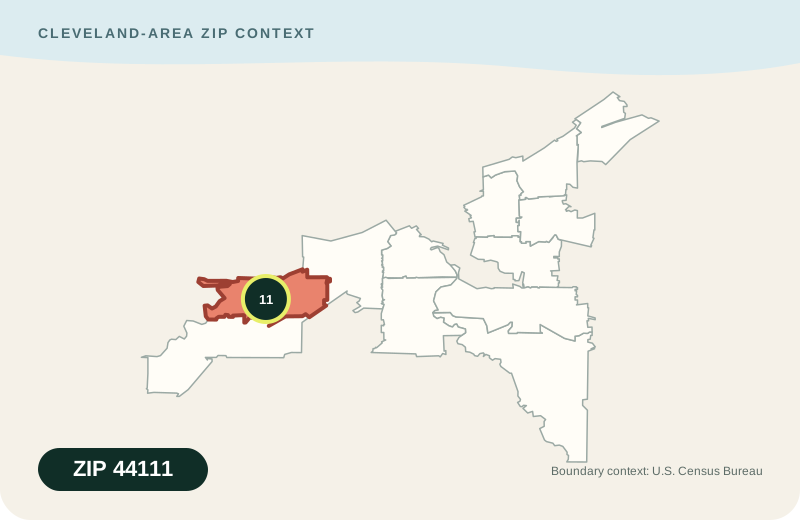
Boundary map highlighting ZIP 44111 among the Cleveland-area ZIP guides
ZIP 44111 is highlighted using U.S. Census ZCTA boundary context. Call to confirm service availability for the property.
Inspection and prevention

Four passes through the building envelope

The same opening can look different from outside, inside, above, and after a door or garage component moves. Each pass answers a separate question.

Call (216) 541-8761
  1. 01

    Evidence pass

    Place droppings, gnawing, sounds, nesting, odor, and sightings by room, height, freshness, and time.

  2. 02

    Envelope pass

    Review foundation joints, siding and trim transitions, doors, vents, roof edges, utilities, and connections to additions.

  3. 03

    Resource pass

    Note waste, pet food, seed, water, vegetation, storage, and low-traffic cover that may keep rodents near the structure.

  4. 04

    Prevention pass

    Rank repairs, control actions, housekeeping adjustments, monitoring points, and work that belongs to another trade.

Why rodent problems show up in 44111

A short outdoor route can connect several separate building pieces

In 44111, a property may place the home, porch or addition, driveway, garage, fence, rear entry, and utility lines close together. Those elements create shelter and transitions even when each part appears ordinary on its own. A mouse can use a small construction gap; a rat may follow a protected ground-level edge toward a larger weakness.

Busy residential routines matter too. Garage doors open, deliveries reach the back or side, recycling and waste move through narrow areas, and stored seasonal items shift against walls. These are not evidence of poor maintenance. They are operational conditions that can hide signs or change access.

Prevention works best when it respects the way the property is actually used. A repair that obstructs a vent, traps water, or fails after ten door cycles is not a durable solution.
Dense-residential home concern

The garage and addition are part of the house story

Detached garages can hold food, seed, fabric, paper, tools, and quiet cover. Attached garages and additions may connect more directly to wall or ceiling voids. Inspect the joint, not just the center of either room.

For a homeowner, this may mean comparing kitchen evidence with the garage-side wall. For a landlord, it can mean collecting reports before rearranging common storage. For a small commercial or mixed-use space, rear access and inventory practices may set the inspection schedule.

Prevention priorities

Make ordinary use easier to monitor

  • Keep inspection lines visible along walls where practical
  • Use appropriate sealed containers for attractive stored goods
  • Correct door alignment rather than relying on loose filler
  • Record recurring evidence before repeated cleanup
  • Recheck repairs after seasonal movement and heavy use

These steps support professional removal and exclusion; they do not replace species identification or active control.

Common rat and mouse issues in 44111

Three property junctions deserve a deliberate comparison

Garage ↔ exterior

Door corners, wall penetrations, and stored goods

Evidence may remain in the garage or continue along a shared wall. Check movement and material condition before choosing a repair.

Likely clues: package damage, tracks in dust, pellets beside walls, or gnawing near the lower edge.
Addition ↔ original structure

Different materials meeting behind finishes

Roof, siding, foundation, and framing transitions can create irregular voids that are not obvious from the occupied room.

Likely clues: localized ceiling sounds, debris below trim, or evidence aligned with the construction seam.
Yard edge ↔ rear entry

Cover and resources approaching a moving door

Vegetation, bins, storage, fencing, and steps can shelter an approach while threshold wear provides the final opening.

Likely clues: exterior tracks or burrows, staining, door-corner damage, or repeated interior pellets.
When prevention becomes active control

Fresh indoor evidence means the plan must address animals already inside

New droppings, recurring sightings, active gnawing, nest material, or repeat sounds call for more than future-facing repairs. Removal, monitoring, sanitation, and exclusion must be sequenced together.

Match fresh evidence to the guide
Rodent proofing and exclusion in 44111

A priority matrix for durable prevention

Not every opening has the same urgency. The best candidates connect to evidence, provide a realistic route, and can be repaired without compromising the building.

Review proofing materials and scope
High evidence + accessible repair
Coordinate closure with active control and monitor both sides of the route.
High evidence + specialized repair
Bring in the appropriate roofing, masonry, structural, electrical, or door professional as needed.
Low evidence + clear vulnerability
Document and rank it; preventively address it when the repair is appropriate and does not interfere with active control.
Low evidence + uncertain function
Do not block ventilation, drainage, or utility access. Investigate before changing the component.
44111 prevention FAQ

Questions about inspection, garages, and repeat-proofing

Should a detached garage be inspected if signs are only in the house?

It can be useful when the garage stores attractive materials or sits along a likely exterior route. Its evidence may explain pressure around the home even without a direct connection.

Can an addition create a new rodent route years after construction?

Yes. Materials move and age, seals fail, and later work changes transitions. Current evidence and present condition matter more than the age of the addition alone.

What is the difference between prevention and exclusion?

Prevention includes resource management, monitoring, maintenance, and entry reduction. Exclusion is the more specific work of denying access through building openings.

Do close neighboring homes mean rodents came from next door?

Not necessarily. Density creates shared exterior conditions, but the route into each building must be established at that property. Avoid assigning a source without evidence.

How often should repaired door edges be checked?

Recheck after heavy use, seasonal movement, weather events, or renewed evidence. Moving components can wear differently from fixed patches.

Can I proof the house before placing traps or other controls?

Some preventive repairs may be appropriate, but primary access closure should be coordinated with the active-control plan so animals are not trapped or redirected.

Turn a long gap list into a ranked prevention plan

Request a rodent-control conversation for 44111

Describe the building, recent signs, garage or addition, and repair history.

Start with a call to (216) 541-8761
Call (216) 541-8761